The Secret History of Capitalism
5 Truths That Change How You See the Modern World

We live within a global economic architecture so pervasive that we treat it as an immutable law of nature, akin to gravity or the orbiting of planets. Yet, while the structures of “capitalism” define the rhythm of our labor and the value of our time, the system’s origins remain obscured by a sanitized mythology of peaceful trade. To peer into the history of its “invention” is to survey a landscape littered with the debris of broken feudal contracts and state-sanctioned enclosure.
Capitalism was not a discovery made in a laboratory, nor was it the inevitable result of human bartering instincts. It was a specific historical accident—a fundamental reorganization of social life that emerged through centuries of upheaval. To understand where we are going, we must first recognize how this architecture was actually built.
1. The Word Was Originally a Weapon
Today, “capitalism” is often brandished as a badge of honor by its defenders or used as a neutral descriptor by economists. However, the term was forged in the mid-19th century as a linguistic weapon by its most fervent critics.
Before it was a system, “capitalism” was a pejorative. Early socialist thinkers like Louis Blanc and Pierre-Joseph Proudhon used the word to diagnose a specific social malady: the concentration of the means of production in the hands of a few, to the exclusion of the many.
“Capitalisme [is] the appropriation of capital by some to the exclusion of others.” — Louis Blanc, 1850
While William Makepeace Thackeray introduced the word to the English-speaking world in his 1854 novel The Newcomes, he used it merely to describe the personal “condition of having capital”—a state of individual wealth. It was the systemic, socialist critique that gave the word its teeth. To those early observers, capitalism was not a synonym for “commerce”; it was a regime of exclusion where the ownership of the world was severed from the people who worked it.
2. Capitalism is Not “Just Markets”—It’s a Compulsory Social Relation
The most persistent myth of our age is that capitalism is simply the act of buying and selling. In reality, markets and trade have existed for millennia—from the merchant networks of the Medici to the bazaars of the Silk Road. What makes capitalism unique is not the presence of a market, but the fact that the market became a master.
In the feudal era, exploitation was a matter of extra-economic coercion: a lord used legal status, customary hierarchy, and the threat of physical force to extract surplus from peasants who still had direct access to their own land and food. Capitalism replaced the whip with the “silent compulsion” of economic necessity. This transition created a “dual sense of freedom” for the modern worker:
Freedom from feudal bonds: The worker is no longer legally tied to a lord or a plot of land.
Freedom from the means of survival: The worker is “freed” from any tools, land, or resources of their own.
By being separated from the means of subsistence, the individual is forced into market dependence. Survival itself is now contingent on selling one’s labor-power for a wage. This specific social relation—private ownership versus a dispossessed workforce—is the actual engine of the system, making the market an unavoidable master rather than a mere place of exchange.
3. The Bloody “Midwife” of Primitive Accumulation
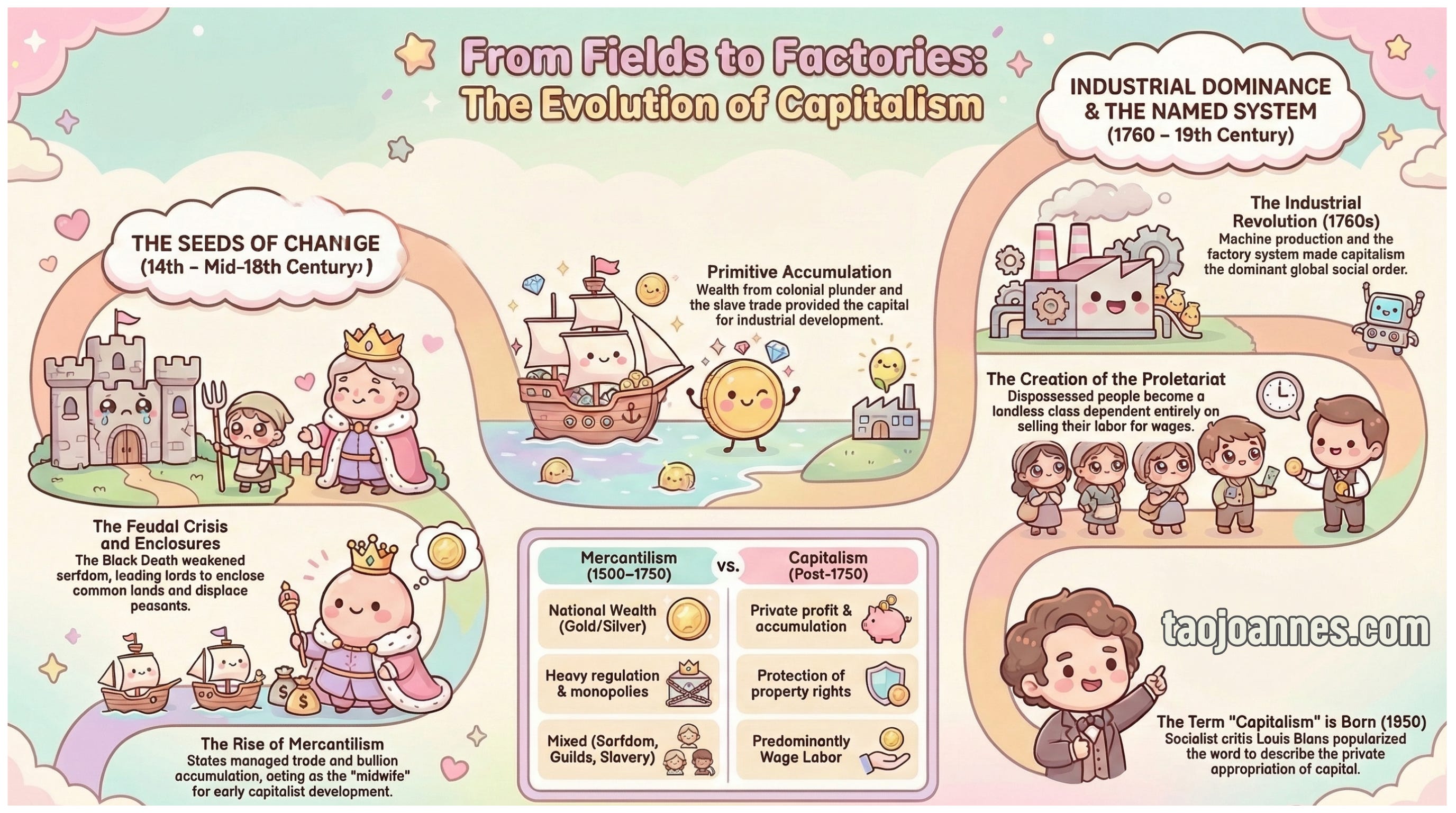
Capitalism did not emerge through the gradual, peaceful accumulation of savings by industrious individuals. It required what Marx called “primitive accumulation”—the violent process of divorcing producers from their means of production to create the “startup capital” and the displaced workforce necessary for industrialization.
The historical record reveals three primary drivers of this transition:
The Enclosure Movement: In England, common lands that had supported the peasantry for centuries were forcibly fenced off and privatized. This “enclosure” turned self-sufficient producers into a landless proletariat, leaving them with no choice but to migrate to burgeoning cities to seek wages.
Colonial Plunder: The seizure of gold, silver, and resources from the Americas provided a massive injection of liquidity into European banks, financing the birth of the factory system.
The Transatlantic Slave Trade: The unpaid labor of millions produced the cheap raw materials—cotton, sugar, and tobacco—that fueled the growth of the global market.
As the history of economic thought suggests, if capital comes into the world, it does so “dripping from head to foot, from every pore, with blood and dirt.”
4. Mercantilism Was the Parent, Not the Peer
We often confuse mercantilism with capitalism, but they operated on fundamentally different logics. Mercantilism was the era of the state-chartered monopoly, where monarchs managed trade as a tool of national power. It was a bridge—a “parent” system that used state violence to clear the path for the private industrial system to follow.
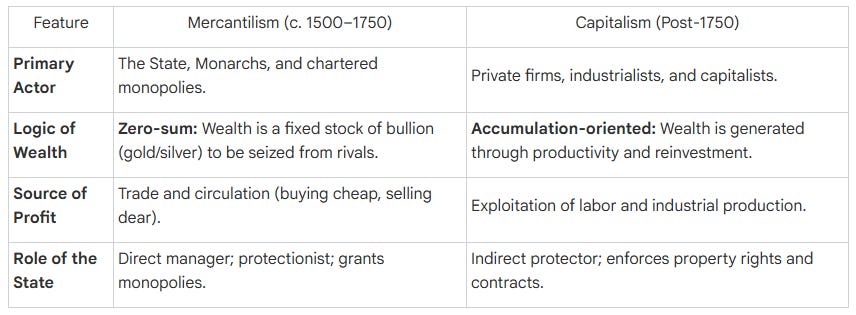
While mercantilism focused on the state’s treasury, it created the very infrastructure—the banks, the naval routes, and the concentrated wealth—that allowed private capital to eventually dismantle the state’s monopolies and take the lead.
5. The Great Debate: An Accident of Property Relations
Was capitalism inevitable? Historians have long wrestled with this through the Dobb-Sweezy-Brenner debate. While Maurice Dobb focused on internal class struggles within feudalism and Paul Sweezy pointed to the “external shock” of expanding trade, it was Robert Brenner who offered the most piercing insight.
Brenner argued that capitalism was not triggered by “more trade,” but by a specific reorganization of agrarian property relations in the English countryside. When landlords and tenants were stripped of their ability to survive through customary rights, they became entirely dependent on the market. This forced a new behavior: the compulsion to innovate, compete, and increase productivity just to keep the land.
This suggests that capitalism was a historical “accident”—a unique set of circumstances that could have gone differently. It was the moment survival became tied to market competition that the “starting gun” of the modern world was fired.
Conclusion: Beyond the End of History
Understanding the history of capitalism reveals that it is a system made by human hands through specific historical processes—not an eternal law of nature. It was forged in the decline of feudalism, the violence of enclosures, and the strategic maneuvering of mercantilist states.
If the structures we live under today were built through centuries of social and political struggle rather than emerging from a natural state of grace, it raises a final, provocative question. If capitalism was “made” at a specific historical moment, it is inherently subject to the same laws of change as the feudal and mercantilist systems that preceded it. If it had a beginning, and was shaped by specific historical choices, what might the next transformation of our economic world look like?